FIRM Model
The Flood Infrastructure Resilience Model project, or FIRM for short, was a Building a Secure and Resilient World’ (BSRW) funded project. Read on to find out more about the model produced from this project from the creator’s viewpoint.
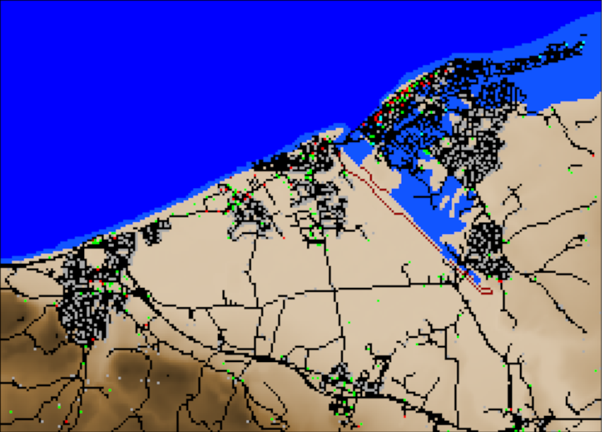
A raster output with the terrain, flood, road network and traffic. Image taken from the DAFNI Platform.
Description of the model
The model consists of roads, buildings, vehicles, defences, terrain and water, all of which are modelled as agents. Agents are defined as probabilistic finite state machines with the probability of being in a given state. Vehicle agents are parameterised using data from the National Travel Survey (ONS and DfT 2008) which gives sample diaries of travel patterns for households, defining the travel patterns and responses during flooding events. Defences have probabilities of being destroyed during flooding, and buildings may enter a “flooded” state.
What does the model do
Floodplain flows are described in terms of continuity and momentum equations, discretised over a raster grid of square cells, which allows the model to represent 2-D dynamic flow fields on the floodplain. Flow between two cells is a function of the free surface height difference between those cells. Traffic is simulated using an implementation of the Nagel-Scheckenberg model which describes a 1-D cellular automaton governing the behaviour of vehicles in a road network.
Why was the model made
The model coordinates the agent behaviour in a time-stepped simulation, producing patterns of flooding, traffic movement, and agent responses to blocked and flooded parts of the road network.
What was envisioned for the model
The original implementation of the model was made in NetLogo to investigate risk-based flood incident management approaches. This implementation was a conversion of the original to Java to run in a Docker container on DAFNI, with configuration and model data re-implemented in JSON. The new implementation will run faster, be available to a wider community, be expandable with other flooding models and agent behaviour, and the conversion to Java offers a more accessible language for further development.
How is the model intended to be used
The FIRM2 model is intended to be used to conduct scenario-based flooding simulations to study the behaviour of traffic populations during flood incidents. The model can explore the impact of a flood event, in terms of number of people exposed to floodwater, according to the time of day, different storm surges and defence failures. Water levels, traffic movement and barrier breaches can be examined. The benefits of issuing flood warnings can be tested, whilst the benefits of different evacuation shelters for saving lives and managing traffic congestion can be explored. The FIRM2 model is standalone and does not require any other models in a workflow.
Contact:
Richard Dawson, richard.dawson@newcastle.ac.uk