RIWS Model
Resilience in Integrated Water Systems project, or RIWS for short, was a Building a Secure and Resilient World’ (BSRW) funded project. The project RIWS uses WSIMOD as the software for simulating water quality and quantity. Read on to find out more about the model produced from this project from the creator’s viewpoint.
Description of the model
The RIWS project focused on performance-based resilience assessment for integrated water systems. Modelling was completed using the Water Systems Integration Modelling framework (WSIMOD), concentrating on a small fluvial catchment area in Luton, north of London.
What does the model do
The RIWS project focused on performance-based resilience assessment for integrated water systems. Modelling was completed using the Water Systems Integration Modelling framework (WSIMOD), concentrating on a small fluvial catchment area in Luton, north of London.
Why was the model made
In the first part of the work, eight challenges around performance-based resilience for integrated water systems were identified via literature review, primarily focusing on deriving consistent results across subsystems and on interpreting resilience results for actionable management. The key was trying to find the metrics so that resilience can be calculated in a unified way and then to use this metric to compare the resilience across the components of the water system.
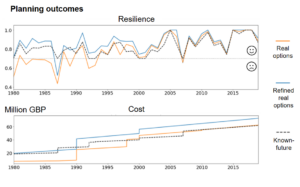
In the second part of the work, the team decided to examine past 50 years and see how far uncertain conditions explored in DMDU were from an idealised (known) solution. The results worked well and could prove to be a way of understanding the effectiveness of their new methods for resilience planning under deep uncertainties via a collaboration with fellow DAFNI BSRW project lead on the USARIS project (Uncertainty quantification and Sensitivity Analysis for Resilient Infrastructure Systems), Associate Professor Dr Francesca Pianosi. This also offers insights into identifying interventions and highlights the importance of accurately characterising climate uncertainties.
What was envisioned for the model
WSIMOD provides the opportunity for researchers to explore complex water system interactions and develop better-informed strategies, leading to more available and cheaper drinking water, reduced flooding and overflows, as well as cleaner rivers and lakes.
How is the model intended to be used
The team sought to create an integrated water systems model and add to DAFNI in order to create new possibilities for researchers. WSIMOD will allow decision makers to start from the river and work backwards to ensure that the infrastructure is sound and avoids spills and pollution.
Contact:
Diego Alonso Álvarez, d.alonso-alvarez@imperial.ac.uk