BRINES Model
The Building Risk-Informed redundancy for Net-zero Energy Systems project, or BRINES for short, was a Building a Secure and Resilient World’ (BSRW) funded project. Read on to find out more about the model produced from this project from the creator’s viewpoint.
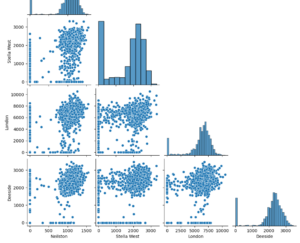
Demand surplus after renewable generation for selected cities.
Description of the model
A probabilistic tool that, using power infrastructure and climate data, estimates the probability distribution of the difference between energy demand and renewable supply. The results can be visualised by the companion visualisation script (Jupyter notebook).
What does the model do
The model processes infrastructure and climate inputs, quantifies uncertainties in both demand and renewable supply, and produces the probability distribution of their difference. It enables users to visualise the likelihood of renewable energy shortfall under different scenarios. The model performs Monte Carlo Simulation (MCS) to assess surplus energy demand after accounting for wind and solar generation, with a surplus of 0 indicating that renewable sources fully meet the demand.
Why was the model made
It was developed to address the distinct characteristics of wind and solar energy supply to conventional sources: higher variability and uncertainty in the amount and the shared dependence on weather with energy demand. The model supports understanding these risks and uncertainties to enable risk-informed decision-making for renewable expansion.
What was envisioned for the model
We envisioned a digital decision‑support tool to guide long‑term renewable infrastructure expansion that is resilient to climate change and informed by uncertainty analysis.
How is the model intended to be used
The intended use is the simulation of power infrastructure configurations (e.g. different generator capacities and/or addition of transmission lines) and climate data under different climate change scenarios. Thereby, one can simulate the varying, evolving risks depending on infrastructure expansion and climate change.
Contact:
Ji-Eun Byun, ji-eun.byun@glasgow.ac.uk