Beyond the journal: how researchers can use LinkedIn to increase impact, visibility and collaboration
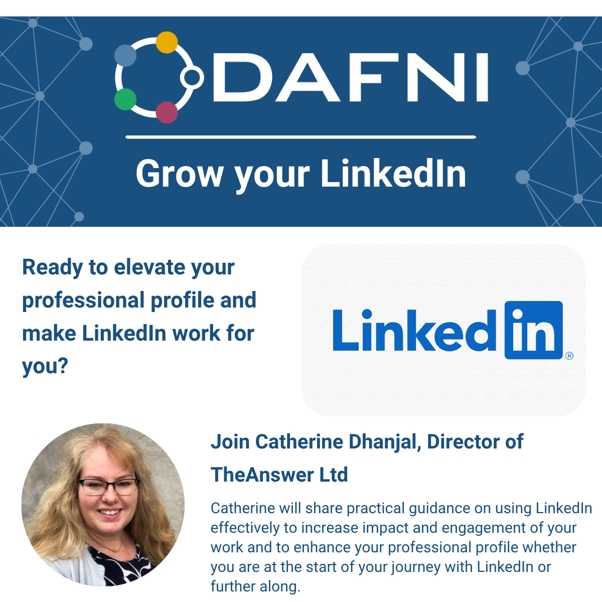
Our July 2026 webinar explored how LinkedIn has evolved dramatically over the past decade. Once viewed primarily as an online CV or professional address book, the professional networking platform has become one of the most effective available for researchers looking to communicate their work, build professional relationships and demonstrate impact beyond academic publishing.
LinkedIn offers opportunities to increase visibility, engage with policymakers and industry, discover funding opportunities and establish researchers as trusted voices in their field.
Speaker Catherine Dhanjal, DAFNI Media Manager, explored how researchers can use LinkedIn strategically throughout their careers, from PhD students and early-career researchers to established academics.
Publishing in academic journals remains essential, but it is no longer enough on its own. Funders, universities and research organisations increasingly expect researchers to demonstrate how their work reaches wider audiences and influences practice. LinkedIn provides a practical way of extending the reach of research and engaging directly with people who may never encounter it through academic publications.
Why researchers should use LinkedIn
Today, LinkedIn combines networking, recruitment, learning, AI-powered search, news and professional publishing. Researchers can showcase publications, conference presentations, project updates, videos and thought leadership while building meaningful professional networks.
An active LinkedIn presence supports research impact, collaboration, dissemination and career development. One of LinkedIn’s greatest strengths is the diversity of its audience. Research shared on LinkedIn can reach academics, industry professionals, policymakers, journalists and the wider public. Because LinkedIn content is indexed by Google, posts can also improve the discoverability of research beyond the boundaries of LinkedIn itself.
A professional profile should include a recent photograph, an informative summary, current qualifications, research interests, publications, and could also include elements such as conference activity and a link to Google Scholar, ORCID or ResearchGate. The Featured section can highlight key publications or presentations.
LinkedIn’s search tools allow researchers to identify collaborators, conference speakers, funding organisations and research communities. Following organisations such as UKRI, Innovate UK and relevant universities helps ensure funding calls and opportunities appear within your feed.
How often to post?
A common question during the webinar was how often researchers should post.
The answer is less often than many people assume. Consistency is generally more important than volume. A thoughtful post once a week, combined with genuine engagement with other people’s content, can be far more effective than posting intensively for a short period and then disappearing.
Useful content might include:
- Research findings and publications
- Conference reflections
- Project updates
- Lessons learned during a study
- Presentation slides
- Behind-the-scenes insights into research projects
Researchers should not feel pressure to become full-time content creators. Instead, they should focus on sharing useful insights and contributing to conversations relevant to their field.
Catherine highlighted that LinkedIn increasingly rewards authentic engagement. Meaningful comments and reposts with additional insight generally perform better than simple likes. Human-written content also tends to outperform generic AI-generated posts, making authenticity an important part of long-term success.
LinkedIn can complement face-to-face networking rather than replace it. Connecting with people before and after conferences helps strengthen relationships, while the LinkedIn mobile QR code feature makes exchanging contact details quick and easy.
Top tips
Researchers looking to strengthen their LinkedIn presence should:
- Review and update their profile at least once a year.
- Write for non-specialist audiences where possible.
- Use images and graphics to increase engagement.
- Tag collaborators and organisations appropriately.
- Upload presentations and documents directly to LinkedIn.
- Share key publications more than once, approaching them from different angles over time.
LinkedIn has become an essential communication platform for modern researchers. Used strategically, it helps increase visibility, demonstrate research impact, attract collaborators, discover funding opportunities and build a professional reputation that extends far beyond academic publishing. Small, consistent actions over time can have a significant influence on the reach and impact of research.
View the recording and slides at: https://www.dafni.ac.uk/news-and-events/events/webinar-optimise-your-linkedin-use/