 News
News
Register for the DAFNI 2026 Conference
Updated on July 10 2026
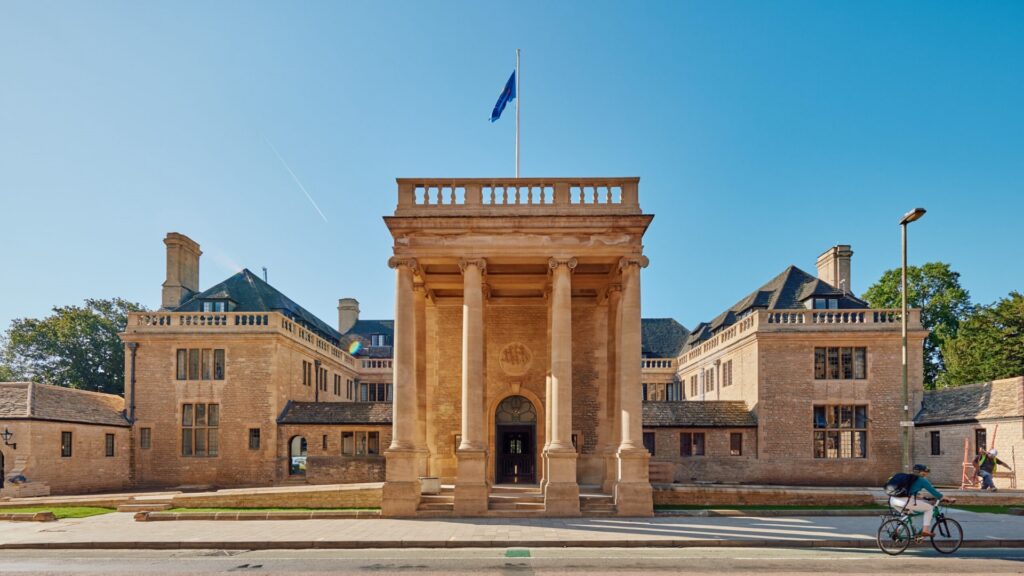
The 2026 DAFNI Annual Conference will be held on Thursday 10th December at the Rhodes House, University of Oxford and registration is open. Our annual conference provides an opportunity to showcase our projects across Government, Academia and Industry from the past year and to share the latest updates from the DAFNI platform.
Our programme will feature keynotes, invited talks and interactive sessions, providing a forum to discuss the sheer breadth of scientific areas that DAFNI engages in. The conference, now in its sixth year, will also be a momentous occasion as we introduce our DAFNI 2026 Fellows.
In the morning, we will focus on: Climate and Security Resilience and afternoon session will explore Government Industrial Strategy, with a focus on Clean Energy.
Endeavouring in the UK government’s mission to achieve clean power and Net Zero by 2030, here at DAFNI we are working on complex and challenging energy projects from forecasting demand to testing the resilience of our systems and grid networks in extreme weather.
We are delighted to announce our fantastic line-up of speakers:
Keynote speakers:
🎤 Jim Hall, FREng, FRS, Professor of Climate and Environmental Risks in the School of Geography and the Environment.
Chair of DAFNI’s Strategy Board, Professor Hall is internationally recognised for his research on risk analysis and decision making under uncertainty for water resource systems, flood and coastal risk management, infrastructure systems and adaptation to climate change. His research focuses on management of climate-related risks in infrastructure systems, in particular relating to various dimensions of water security, including flooding and water scarcity.
🎤 Margaret Read, Strategy and Policy Director (Interim) at the National Infrastructure and Service Transformation Authority (NISTA).
Margaret was previously Director of Policy at the National Infrastructure Commission, where she led the Commission’s policy work on energy, water and wastewater, flood risk management and infrastructure resilience. Before her role at the Commission, she worked as part of the RAPID leadership team, a joint Ofwat, Environment Agency and Drinking Water Inspectorate unit to speed up water supply infrastructure delivery. She has extensive experience leading policy development in Whitehall, principally on water supply, flood and coastal erosion risk management, access to the environment and a number of other environmental issues. Her teams have supported Ministers in developing primary and secondary legislation and in working with delivery bodies to implement policy.
Invited speakers:
I am excited to announce our fantastic line-up of Invited Speakers:
🎤 Professor Femke Vossepoel, TU Delft, will be speaking about our UrbanAIR project.
The goal of UrbanAIR is to develop a new digital twin that supports decision-makers in urban areas to deal with urban design dilemmas in atmospheric heat and air quality to maximise the health and socio-economic well-being of its citizens affected by climate change.
🎤 James Daniel, UK Power Networks and Elliot Christou, Connected Places Catapult will be speaking about CReDO.
The Climate Resilience Demonstrator (CReDO) is a groundbreaking digital twin project, connecting digital twins across infrastructure and services to demonstrate how connected data and greater access to the right information can improve climate adaptation and resilience.
🎤 Professor Campbell Booth, University of Strathclyde will be speaking about the ENSIGN project.
ENSIGN is creating an Integrated Energy System Digital Twin (IES‑DT) to help the UK manage the complexity of future multi‑vector energy networks. By linking digital twins across electricity, heat, hydrogen and industrial clusters, it will enable smarter planning, real‑time operation and whole‑system optimisation.
We welcome participation from people in academia who have an interest in climate analysis, energy, environmental science, digital twin modelling, transport, visualisation, AI, data analytics and engineering infrastructure.