CReDO+
The Climate Resilience Demonstrator (CReDo) is a groundbreaking digital twin project that focuses on how to mitigate the risks of climate change for critical national infrastructure networks
Updated on October 21 2026
The CReDO (Climate Resilience Decision Optimiser) project focuses on how to mitigate risks of climate change such as extreme heat and flooding for critical national infrastructure networks, in particular electricity and water.
The Discovery phase known as CReDO (Climate Resilience Demonstrator), was a six month period to develop the initial idea, funded by the Strategic Innovation Fund (dates). It involved Ofgem and OFWAT.
The second phase was Alpha, involving a year’s prototyping (dates). It involved Ofgem and OFWAT and regular monthly plenary meetings to cross share ideas and experiences between the infrastructure operators from both areas.
The Sif-funded CReDO+Beta Ofgem is the current phase, running from 2023-2027.
Now known as the Climate Resilience Decision Optimiser, this phase is building a digital platform for operators of critical infrastructure systems. The platform combines asset data, environmental data and advanced modelling techniques to simulate how these systems behave under stress.
Its focus is on mitigating the impacts of extreme heat or flooding.
The project brings together data from energy, water and telecommunications sectors into a single geospatial platform hosted by DAFNI, enabling users to visualise physical assets and their interconnections.
Protecting critical national infrastructure and ensuring its smooth operation is essential to government, businesses, health, schools and daily life of individuals.
DAFNI provides the trusted platform that allows critical national infrastructure data from electricity and water operators to be shared. An important element of the work is formatting the data then loading it onto a special version of the CReDO-DAFNI platform and digital twin, which is hosted on separate hardware and features stricter security controls and encryption keys than the usual version of the DAFNI platform.
Detailed asset data from electricity and water operators around the UK is linked on DAFNI. This allows organisations to see the impacts and cascading effects of an issue, beyond a single asset. For example, loss of power in a pumping station can cause flooding across local roads, and in turn that flooding can make access to the pumping station challenging for engineers. Similarly, the cascade effect of a primary electricity station breaking down on substations can be modelled and visualised.
The linkages and intersections between electricity infrastructure providers (Distribution Network Operators) is also captured, identifying where electricity flows between different operators. These linkages and hand-offs will become even more important as energy becomes more renewable – requiring bigger connections between providers and a more complex network map to accurately identify the multiplication of connections, coordination and transfer of energy between different organisations and newer parts of the energy system such as wind farms, solar parks, battery storage, hydro and local generation schemes.
Connected Places Catapult works within the CReDO+Beta project to bring new operators onto the platform. It showcases a data demonstrator using synthetic data, negotiates the bilateral data sharing agreement between each operator and DAFNI and standardises the data by formatting before its uploaded onto the digital twin. SP Energy Networks (part of Scottish Power) is the latest addition to the project.
The system allows CReDO-DAFNI platform users to explore the datasets and examine risks at individual asset and network level, without seeing other organisations’ data. Operators could identify a failure in one of their nodes and see that it’s the result of a cascading issue from another operator’s network without seeing the detail of their asset.
Risks modelled range from ‘four days of 35degreeC plus temperatures’ to ‘one in 100-year flood event’.
Current activity in CReDO+Beta (2026)
The project is now looking at how assets might fail or degrade due to the impacts of extreme heat as well as flooding.
The failure models are also being made more sophisticated, moving beyond ‘failed’ or ‘working’ to capture degrees of sophistication, such as partial failures or early signs of degradation. This is particularly important with the impacts of extreme heat.
Next steps
Longer term there could be the possibility to extend the project to bring economics or cost implications into the data and modelling. For example, to highlight certain nodes that are more critical to protect because they will cause more devastating cascading impacts than other nodes or assets.
The elicitation tool (failure identification tool) within CReDO+Beta is being developed to track each component and sub component of a substation, capture when it was installed, who installed it, when it is due to be replaced under normal maintenance schedule, and to send that information back to DAFNI.
Further developments to the elicitation tool could involve adding work from the USARIS project (Uncertainty Quantification and Sensitivity Analysis for resilient Infrastructure Systems), to enable electricity operators to model at different levels of fidelity.
Whilst CReDO+Beta Ofgem focuses on gas and electricity energy data, future projects could focus on water or transport, subject to funding being obtained.
DAFNI sees the potential to mirror its CReDO-DAFNI platform featuring additional encryption and security to make it available to other users with sensitive data, in the mobility field, for example.
Live data is not currently captured in CReDO but could be in the future as components are already fitted with sensors which could be transmitted into the CReDO-DAFNI platform as part of a subsequent project.
Whilst the current programme focuses on mitigating impacts of extreme heat or flooding, a future work project could focus on looking at how infrastructure operators might achieve Net Zero.
Find out more on the Digital Twin Hub website.
Meet the Project Lead
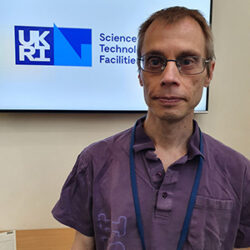
Dr Jens Jensen
DAFNI