 Case studies
D-RES: electric vehicle batteries for back-up household power supply
Introduction
The D-RES (Distributed Resilience from EVs during Extreme Weather Events) project demonstrated that electric vehicles can keep the lights and heating on during extreme storm events by providing extra resilience to the power grid. It focuses on mobilising idle electric vehicle batteries as a power source during extreme weather events when the grid is under stress and struggling to meet the energy demand from the end-users.
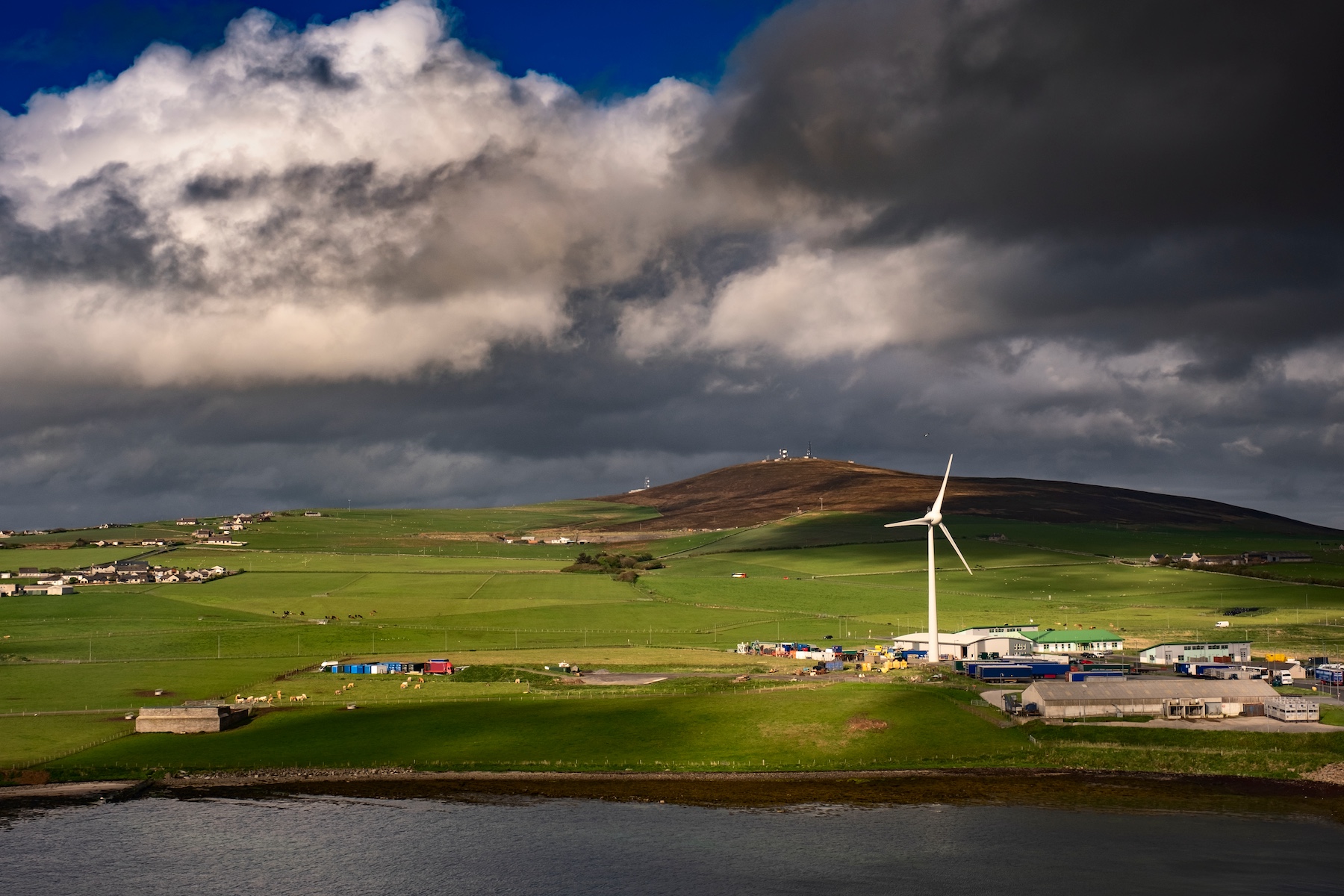
A case study of the Orkney Islands was chosen due to their high Electric Vehicle (EV) penetration, frequent storms, renewable energy resources and available data.
The work is particularly timely given the increase in decarbonised energy generation, EV uptake and the impact of the extreme weather in recent years.
What would you identify as the main impact of this work?
The D-RES project pioneered work on the scope to use batteries from EVs as alternative back-up energy sources from the grid during extreme weather.
Thanks to the unique features of the Orkney Islands, the place-based study used real data rather than synthetic data. It demonstrates the place-based impacts and opportunities for the grid operators, end-users, EV owners and other stakeholders to take this approach.
Thanks to reusability being embedded from the beginning, the models and workflow allow other researchers to use them for their own place-based research and to include the specific weather conditions, generation, demand, storage and infrastructure data for that location.
The research outputs have been made more accessible to non-technical users, such as policymakers. The work demonstrates that areas subject to weather extremes driven by climate change could make good use of EV batteries as back-up power options if they have existing EV uptake and EV charging infrastructure.
Key challenges that D-RES aims to solve
The scientific challenges focused around designing a response to extreme weather events from EVs, and modelling an algorithm of response. The data for more severe meteorological events is necessarily scarcer than for ‘business as usual weather’, so the challenge included designing algorithms for the more infrequent weather extremes.
The research challenge was to achieve this in a redeployable and modular way, so that it could become a resource for researchers to keep building on it and interacting with it.
Whilst the D-RES project focused on storms and EVs on the Orkney Islands, the research parameters are editable, so that it could be used on the Shetland Islands for heat pumps and heat waves, for example.
What was the key aim of the project?
The main aims of D-RES were to:
- Identify whether EV batteries could be used to keep power flowing during extreme storms
- Design algorithms for EV response to extreme weather events
- Create redeployable models that others can build upon to study different locations.
What did DAFNI allow you to that you couldn’t have achieved otherwise?
The funding allowed for collaboration between the University of Edinburgh and University of Bath. The lead PIs became aware of each other’s work during the early presentations that were integral to the DAFNI pitch process.
D-RES supported early career researchers at a critical time. In 2025, Dr Desen Kirli, transitioned from the Elizabeth Georgeson Research Fellowship to an open-ended Lectureship in Net Zero Energy Systems, at the Institute for Energy Systems, University of Edinburgh. Laiz Souto progressed from being a Research Fellow at University of Bristol to an open-ended Lectureship at University of Bath.
“The project was very impactful in terms our reputations as researchers and our visibility, and contributed to both myself and Dr Souto securing academic positions,” Dr Desen Kirli, Lecturer and Elizabeth Georgeson Research Fellow, University of Edinburgh
The project led to the establishment of a research partnership between the University of Bath and University of Edinburgh, the “Edinburgh and Bath Energy Research Collective” which currently includes Laiz Souto, Desen Kirli and four PhD students. The aim is to grow bigger and collaborate nationally and internationally.
“Significant stakeholder engagement was made possible through the project, involving organisations such as UK Power Networks, Scene Community, Scottish Climate Intelligence Service, Dukosi, Lloyds Bank, Climate Springboards, Supergen Energy Networks, EPCC, DARe Hub, Transit and VPP-WARD project partners,” Dr Desen Kirli, University of Edinburgh.
The main outputs from D-RES available on DAFNI are:
Datasets:
- EV usage and public charger location data
- Wind turbine and other renewable outputs from Orkney Islands
- Electricity tariffs and pricing
- Electrical network infrastructure layout for Orkney Islands
- Weather data including both regular and extreme weather
Models created:
- Power flow model of Orkney’s network
- Optimisation model for optimal EV scheduling
- Smart charging and vehicle-to-grid model
- All housed in one workflow called D-RES
How could this work benefit society as a whole?
The project will help populations subject to frequent or increasing weather events to become more robust in energy terms, helping them to keep the lights and heating on during extreme storms that might have otherwise resulted in a power cut. It estimates that the potential and value of idle EV batteries provide an invaluable distributed resilience bridge to counter-act grid imbalances, leading to outages. Policymakers and local councils can build on the work to identify incentives to encourage EV users to make their batteries available beyond their own immediate households.
How do you anticipate other researchers, policymakers and stakeholders using this work?
The reusable nature of the models and workflow will allow researchers to run case studies for different extreme weather scenarios, different locations or assets other than EVs. It can interface with other models in DAFNI, such as flood scenarios and data.
Policymakers can use the evidence to explore and develop policies supporting vehicle-to-grid technology and to create incentives for upgrading EV chargers to be vehicle-to-grid compliant. Additional applications include addressing fuel poverty through increased grid resilience.
Papers are in progress discussing the D-RES framework, and weather-informed optimised EV scheduling work.
The future
Future work will integrate other renewable energy and storage technologies to capture wider possibilities. We will investigate other case studies with varying factors, such as urban locations, to validate the outcomes for different locations.
Who’s involved
Principal Investigator: Dr Desen Kirli, Lecturer (Assistant Professor) and holder of Elizabeth Georgeson Fellowship, University of Edinburgh
Co-Investigator: Dr Laiz Souto, Lecturer, University of Bath (formerly Research Fellow, University of Bristol)
Dr Peter McCallum, Post-doctoral Research Associate, University of Edinburgh
Mr Weizhe Killua Qin, Research Assistant, University of Edinburgh
When did the project start and finish?
The project ran from June 2024 to March 2025.