Making environmental data work harder: the NERC Digital Solutions Hub
Unlocking the true value of environmental data has long been a challenge for researchers, policymakers and industry alike. While vast quantities of data exist, accessing and applying it effectively remains a persistent barrier, particularly outside academia.
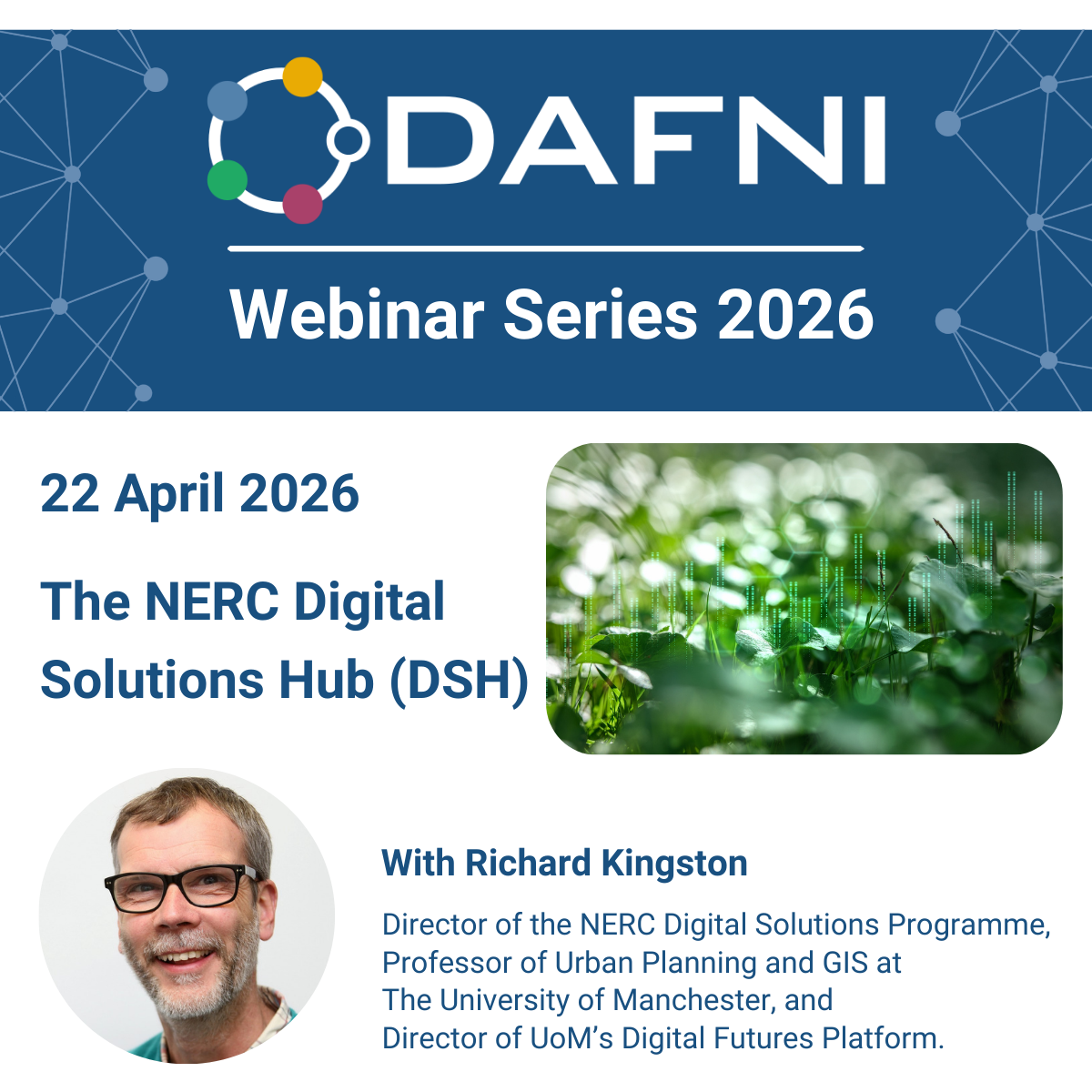
In April 2026, a DAFNI-hosted webinar shed light on how the NERC Digital Solutions Hub (DSH) is tackling this problem head-on. Led by Professor Richard Kingston of the University of Manchester, the five-year project is rethinking how environmental data is used across the UK, using a combination of user-led design, open data principles and emerging AI technologies.
From data abundance to data usability
The starting point for the project is a familiar paradox: the Natural Environment Research Council (NERC), the UK Research and Innovation’s environmental science research arm, already holds an enormous volume of environmental data.
NERC operates five data centres: the Centre for Environmental Data Analysis (CEDA), the UK Centre for Ecology and Hydrology (UKCEH), British Antarctic Survey, British Geological Survey and the British Oceanographic Data Centre. Together they hold an around 40 petabytes, far beyond what most organisations ever deal with.
However, much of this data is underutilised beyond specialist research communities.
The aim of the NERC Digital Solutions Hub (DSH) is to unlock its value more broadly, particularly by combining environmental data with social, economic, health and other environmental data.
The DSH programme
The NERC Digital Solutions Hub is an £8 million investment running from 2021 – October 2026, designed to transform how this data is accessed and used.
Its primary aim is to make environmental data more accessible, discoverable and usable, particularly for organisations outside academia, including public sector, charities and the private sector.
Crucially, the project is grounded in the FAIR data principles — ensuring that data is Findable, Accessible, Interoperable and Reusable.
Designing around real users
Rather than building a platform in isolation, the team began by engaging directly with users across the UK. Through a series of workshops, they mapped how different organisations interact with data, from identifying problems and sourcing datasets to analysis and decision-making.
What emerged was a common frustration: accessing and preparing data often consumes the majority of time and resources.
“People spend a lot of time getting data, finding data, wrangling that… and only then can they start doing analysis,” adds Professor Richard Kingston.
This insight shaped the development of the Digital Solutions Hub. Instead of simply providing access to raw datasets, the project focuses on delivering ready-to-use data services, reducing the technical burden on users.
The Hub will be an online open-access resource available for anyone to access. Users will likely include civil servants, local government officers, members of the public, academics, town planners, health/environmental analysts, charities, public organisations, and any other interested party who may benefit from access to a wide range of environmental, social, health and economic data.
Much of the data is free to access for non-commercial use, such as research, policy or public service. Some of the highly sensitive data is subject to licensing restrictions and sometimes at an associated cost via relevant data centres.
AI meets environmental data
One of the most innovative aspects of the hub is its use of artificial intelligence to transform how users search for data.
Traditional data catalogues rely on keyword searches, which can be a barrier for non-specialists unfamiliar with technical terminology. The DSH addresses this by introducing natural language search capabilities powered by large language models.
“We built an interface which allows you to ask natural language questions and identify datasets that can help answer them,” adds Professor Richard Kingston.
To ensure trust and accuracy, the project uses a retrieval-augmented generation (RAG) approach.
He explains, “The responses it’s giving you are coming from the metadata, so we know we can trust what it’s telling us.”
For example, asking “Where will be the hottest place in the UK in 2030?” previously returned no results. Now it returns relevant datasets using large language models grounded in the metadata and associated documents for the datasets in DSH.
Connecting data across domains
Another key innovation is the use of Unique Property Reference Numbers (UPRNs) to link environmental data to specific locations. This allows datasets to be connected at a much more granular level, opening up new possibilities for analysis.
Users can select areas, attach environmental data like noise or pollution, and export it for analysis. This supports research into environmental health impacts, such as cancer studies.
From data to decision-making
Beyond data discovery, the hub is designed to support real-world decision-making through practical applications and use cases.
“It’s demonstrating the art of the possible… rather than just presenting a data portal that people don’t know how to use,” Richard adds.
Real-time insights
The platform is also evolving to incorporate real-time data feeds, including river levels, wind and traffic data, uncovering opportunities for more responsive decision-making.
So, if air pollution reaches a critical level, hospitals will know that patients start arriving within 36 hours.
DAFNI’s role
DAFNI and the DSH programme are both interested in connecting research platforms and sharing data. The DAFNI programme through the DSH programme has explored connecting to the CEDA archive.
CEDA holds specialist climate data, including earth observation datasets, airborne and satellite data, imagery and observations, and numerical weather predictions.
The DAFNI Data Bridge tool is expected to be released in autumn 2026.
CEDA Archive data will be available via the DAFNI platform, without DAFNI researchers having to obtain individual datasets or carry out manual data transfers or downloads. Data will therefore be accessible to modelling scientists working on projects in the climate and infrastructure field.
The data ingestion project has applicability to the DSH programme, as it has been created to be reusable across other platforms, offering the potential to open links between data in the other NERC projects and the Data Solutions Hub.
Looking ahead: a tool for practical input
Ultimately, the Digital Solutions Hub represents a shift in how environmental data is positioned, not just as a research asset, but as a tool for practical impact.
As Richard explains, “real value is extracted from the NERC data when it’s connected with other social, economic and health data”.
Two use cases will be available on the Hub:
- The ‘climate ready nation’ focusing on housing and ensuring that new housing developments take into account sustainability, social and economic factors at the planning stage.
- The ‘healthy nation’, concentrating on air pollution and health. For example, allowing NHS trusts to monitor real-time air pollution in their area and respond more effectively to poor air quality by ensuring more staff are rostered for expected A&A admittances for respiratory problems.
The project approaches its end in October 2026, after which the hub will be open for live user enquiries.
Sign up to the NERC DSH newsletter to be advised when early access goes live: https://www.digital-solutions.uk/index.php/sign-up-to-our-newsletter/