Reflecting on our 2025 Conference
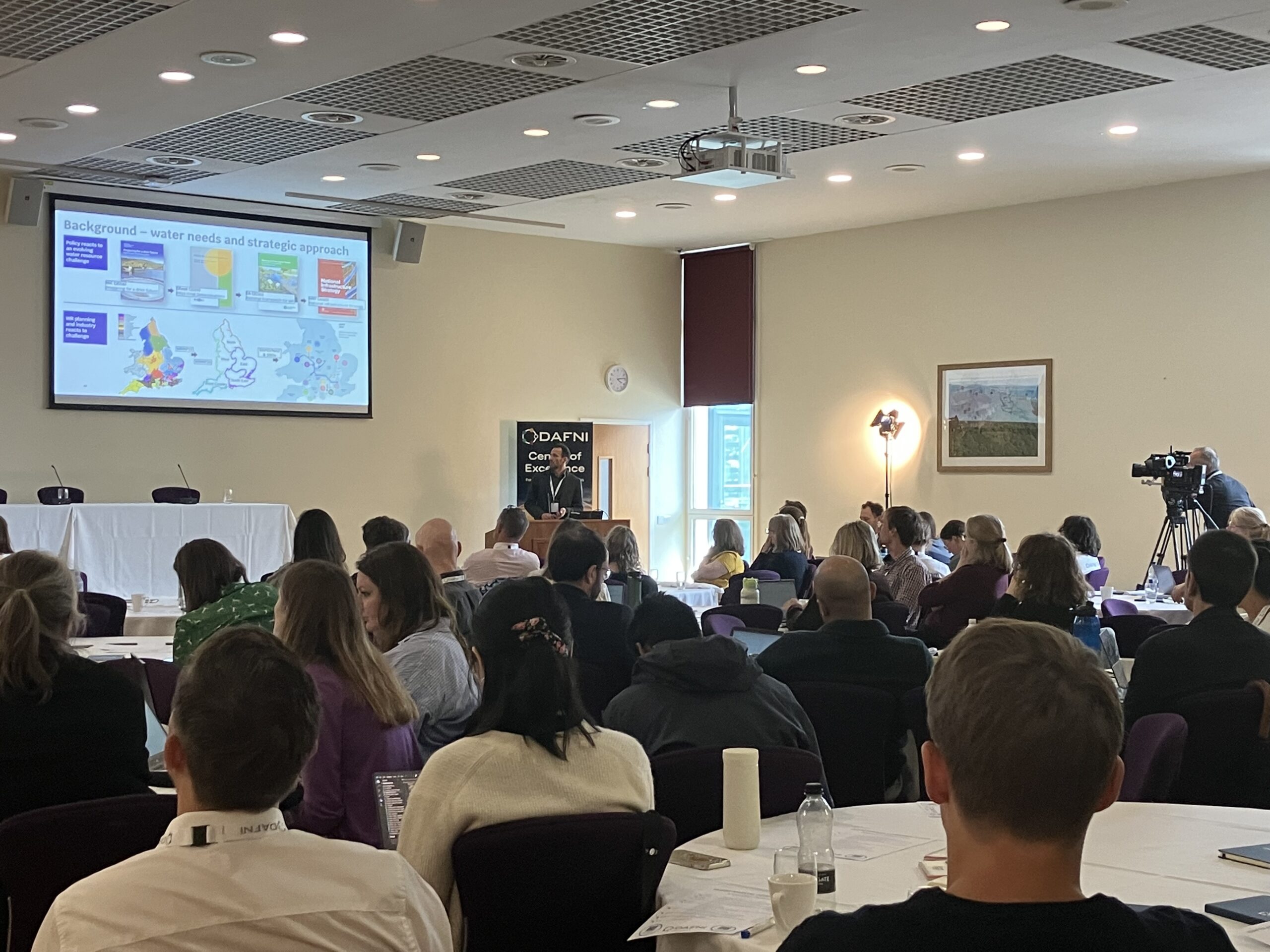
On 12th September 2025, DAFNI held its annual conference at The Edge, University of Sheffield. This year’s theme was ‘Bridging the Gap between Academia, Industry and Government’.
DAFNI Science Lead, Tom Kirkham, introduced and co-chaired the sessions with Dr Giuliano Punzo, Director of University of Sheffield’s Urban Flows Observatory and a member of the DAFNI strategy board. Giuliano welcomed attendees to Sheffield, noting that Sheffield is a natural home for this year’s conference thanks to the university’s strong links with Sheffield’s stainless steel industry and infrastructure.
Keynote talk: Dr Juliet Mian, Director of Arup’s Climate Services and Sustainability Making good choices
Opening her talk, Juliet described how she had needed to travel by train from Birmingham to Sheffield to attend the conference. Using the National Rail app, allowed her to have information based on data to make choices about her journey. Choices in infrastructure are made based on data and analytics, but it is not all black and white – how we visualise and communicate is important.
With a background in engineering, Juliet has a keen interest in shaping a better world and delivering the infrastructure to make communities thrive. Arup’s circular resilience framework is geared towards a whole system response. Understanding long term impacts and refreshing strategy plans will help to drive forward impact, and putting communities at the heart of strategy and development will deliver better outcomes, she highlighted. Proactive and preventative maintenance saves significant monies, but adaptation and preventative decisions are not always taken. DAFNI data and analytics can help solve cost benefit analysis decisions and provide evidence to help.
Sarah Byrne, Senior Software Engineer and Product Owner
DAFNI update
Behind DAFNI’s continued growth is a dedicated technical team comprising research engineers, DevOps specialists, and a user liaison group. Together, the technical team have worked to strengthen the platform, broaden access, and prepare for the future.
Key focus areas over the past year have included:
- Platform security: A full security review has been completed with a transition to a new Kubernetes structure.
- Deployment enhancements: Flux/Helm adopted for streamlined app and service deployment.
- Workflow expansion: A new step type introduced, increasing model iterations from 50 to 400.
- User accounts: Expert and basic user tiers facilitated, with basic accounts offering instant access to models, data catalogues, and more.
Sarah described how the team has begun investigating how DAFNI platform and the STFC cloud could work together to offer a hybrid solution. This would allow users to request additional GPUs or compute power on demand, offering greater flexibility for complex projects.
Work is underway to enable seamless data integration between DAFNI and JASMIN, as well as strengthening access and security. Looking ahead, the coming months will bring hardware updates to further enhance performance and new ways to display. Sarah concluded with an open invitation to users to help shape DAFNI’s future development.
Dr Richard Kirkham, Senior Lecturer at University of Manchester
SALIENT: Building a Secure and Resilient World: Research and Coordination Hub
The SALIENT programme represents a £4.3 million, five-year investment dedicated to strengthening resilience at community, local, and national levels. Drawing on expertise from engineering, anthropology, organisational psychology, business management, and other disciplines, their initiative fosters collaboration around a shared vision in line with DAFNI’s 2025 conference themes: improving resilience and enhancing national security.
Based at the Thomas Ashton Institute in Manchester, the programme is organised around three key areas – professional services and project management, benefits realisation, and value for money. Rapid response funding has been piloted to support urgent, interdisciplinary research on emerging threats, such as drone incursions into high-security prisons and rapid testing for environmental hazards, such as mould.
Rachael Steller and Karina Rodriguez Villafuerte, Resilient Infrastructure Lead Analysts, Climate Change Committee (CCC)
Assessing the resilience of infrastructure in the UK
The Climate Change Committee (CCC), established under the Climate Change Act, provides independent advice to government on climate policy to ensure that the UK is prepared for the impacts of climate change. Rachael introduced the CCC’s Adaptation Progress Report for 2025, which outlined that effective adaptation requires collaboration across disciplines and sectors. By engaging stakeholders, the CCC can draw on the broad range of knowledge available in the community to strengthen resilience and ensure that adaptation strategies are practical, inclusive, and evidence based.
Their findings revealed that the UK’s preparations for climate change remain inadequate, with significant gaps in data and information. This is where CCC’s Climate Change Risk Assessment (CCRA4) comes into place which will identify risks that need to be managed; outline actions required to respond to those risks; recommend what governments should do to ensure delivery; and finally, explore indicators to track adaptation progress.
Nicholas Vasilakos, Professor of Sustainable Business Economics and Public Policy and a Senior Economic & Policy Advisor, University of East Anglia
Climate Extremes and Income Inequality: First Glimpses of Econometric Evidence and Policy Insights from the CROSSEU Project
Extreme weather events consistently affect lower-income individuals and communities more severely. Limited savings, inadequate insurance, and insecure employment mean that climate shocks often translate into lost incomes, rising debt, displacement, and reduced adaptive capacity. In some cases, these pressures can even contribute to political instability. Such a challenge speaks directly to the mission of DAFNI, which enables data-driven, evidence-based infrastructure planning across the UK. By integrating socio-economic data with climate risk models within CROSSEU, DAFNI supports more resilient and equitable decision-making.
The CROSSEU research programme is developing a cross-sectoral framework for socio-economic resilience to climate change and extreme events in Europe. This is not simply an academic exercise; it is a policy-strengthening framework designed to help the EU confront uncertainty and prepare for future risks. Case studies are essential, as they ground research in real-world contexts, validate findings, and engage stakeholders across a diverse mix of hazards and geographies. Findings so far highlight the complexity of climate change and the urgent need to integrate climate justice into policy frameworks at both European and global levels. Addressing inequality is not only a matter of fairness—it is essential for building resilience to climate extremes.
Dr Sarah Hayes, Chair Digital Twin Hub Data Sharing Working Group, Independent Consultant
Do it once and share it many times
Sarah focused her talk on the CReDO (Climate Resilience Demonstrator) project, which is hosted on the DAFNI infrastructure, enabling this groundbreaking digital twin project. CReDO is connecting digital twins across infrastructure and services (a systems-based approach) to demonstrate how connected data and greater access to the right information can improve climate adaptation and resilience.
Creating CReDO has required the involvement of multiple organisations. While many data-sharing initiatives are emerging, they often lack a common language. This made it difficult to understand who was working on issues such as data licences or ontologies, and where best practice truly lay. Use cases were connected, however, without alignment, progress risked fragmentation.
To address this, the Data Sharing Working Group was established in 2022. Its purpose is to share best practice in a collaborative way; tackle the many challenges of data sharing and interoperability; and, like DAFNI’s theme this year, bring together academia, government, and industry. The Working Group has hosted sessions featuring initiatives such as DAFNI-DINI, Stream, NUAR, and Energy Data Sharing Infrastructure. Upcoming sessions will explore industrial strategy, data valuation and smart data. The UK’s Industrial Strategy highlights the importance of robust, secure, and interoperable data-sharing infrastructure, so the Working Group plan to offer opportunities to contribute and shape the future of data sharing.
To join the Data Sharing Working Group, contact Sarah on LinkedIn: https://www.linkedin.com/in/sarah-hayes-8895433/.
Oliver Tones, Head of Data Sharing and Technology, Department for Science, Innovation and Technology (DSIT)
Learning to Fly: Research Data Access Pilots
The UK’s Industrial Strategy highlights the importance of unlocking the value of data. Yet, data access remains suboptimal, constrained by barriers, such as the quality of datasets and legal frameworks.
Oliver introduced four pilot projects which have been launched to explore solutions:
- Safe People Registry (HDR UK): A tool to reduce risks for Trusted Research Environment (TRE) owners and users, providing a clear, plain-English explanation of what TREs are.
- FAIR Data Accelerator (UK SKA): A social sciences lens, recognizing that data access will not improve without accompanying social change.
- DINI (DAFNI): Our project investigated how to scale up to a national infrastructure, addressing barriers and working with data holders to mitigate incentive problems. To learn more about the DINI project and its outcomes, please read here.
- BOOST-EDS (NERC): Developed a globally unique approach to complex citations, improving how data is used across the UK’s largest collection of environmental science datasets.
Working with partners as a cohesive whole has created new connections and synergies. The UK now hosts approximately 100 Trusted Research Environments, underscoring the scale of activity and the need for coordination. Lessons learned so far have been that even modest funding can build momentum for broader change; improving data access does indeed require a whole-system approach as Juliet Mian addressed in her keynote talk: and finally, that data sharing is often viewed primarily through the lens of risk, but incentives must also be considered. Capturing the value of data through the Industrial Strategy offers a powerful driver for change. The UK’s high data protection standards provide a strong foundation. The challenge now is to balance these safeguards with mechanisms that encourage innovation, collaboration, and the full realisation of data’s value.
Following this talk, Catherine Jones, Energy Data Centre Lead, UKRI/STFC and Elizabeth Newbold, Open Science Theme Lead, STFC discussed the results and recommendations from DAFNI’s DINI project, for which the report is available here. How do we unlock the full value of the UK’s research, innovation, and public-sector data? The DINI programme (Data Infrastructure for National Innovation) set out to answer that question by taking a grounded, situational analysis approach. Participants examined both the benefits and barriers of data sharing at scale, worked across multiple regions and sectors, and engaged partners to understand what a National Data Infrastructure should look like in practice, with recommendations on how to move forward. Catherine and Elizabeth described how problems in accessing and sharing data have impeded the interaction between researchers and partners in industry and government. Our participants highlighted barriers to data sharing, particularly the priority that data suppliers give to sharing data safely and securely. Our final report made sixteen recommendations which address these challenges. Together, these characterise a research data cloud to coordinate and sustain the management of data so it can be shared with the academic sector while satisfying the concerns of data suppliers.
This was followed by a Trusted Research Panel, with panel members Emily Jefferson, Health Data Research UK, Jason Feehily, University of Nottingham, David Batho, Jisc, Tash Buckley, Cranfield University and Kathryn Dally, UK Research Integrity Office.
The panel discussed how the UK has a thriving research and innovation sector that attracts investment from across the world. Supporting and enabling safe and effective collaboration in research and innovation is essential in maintaining the integrity of collaboration. More than half of UK research is a product of international partnerships and trusted research is vital to the continued success of the UK’s research and innovation sector.
Holger Kessler, AtkinsRéalis
From hackathon to legislation – the journey of NUAR
Holger introduced the National Underground Asset Register (NUAR). There are around 4 million kilometres of underground pipes and cables beneath our feet in the UK, with 60,000 accidental strikes on these every year – costing the UK economy £2.4 billion per year and putting workers’ safety and lives at risk.
There is a legal requirement to make the data from this huge network available. However, obtaining it requires contacting multiple sources, with the data provided in different formats, scales and to varying timeframes. This process is time consuming for both asset owners, who are supplying the data, and for infrastructure project planners, who need access to the data. NUAR is a government-led programme aimed at more efficient information exchange by creating a single, digital data-sharing platform on the location and condition of underground assets. It is a secure data-sharing service that provides an interactive, standardised digital view of the underground assets in a given location.
Jonny Wilson, Environment Agency
National Water Resources Quality Modelling: From research to delivery
Jonny vividly painted a picture of the evolving picture of the nation’s water needs and solutions. Projections show that our nation will need an additional around 4,940ml/d by 2050 as of June 2025, an increase of c 1,500ml/d since the first National Framework, published in 2020. He discussed significant new infrastructure options, highlighting the trilemma of affordability: security of supply (growing demand, leakage, impact of climate change and droughts) and environmental impacts.
The long-term goal is to have a model that covers all these aspects whilst noting that national modelling does not replace the detailed individual water company, solution and regional modelling work.