Reflecting on the 2026 DAFNI Conference
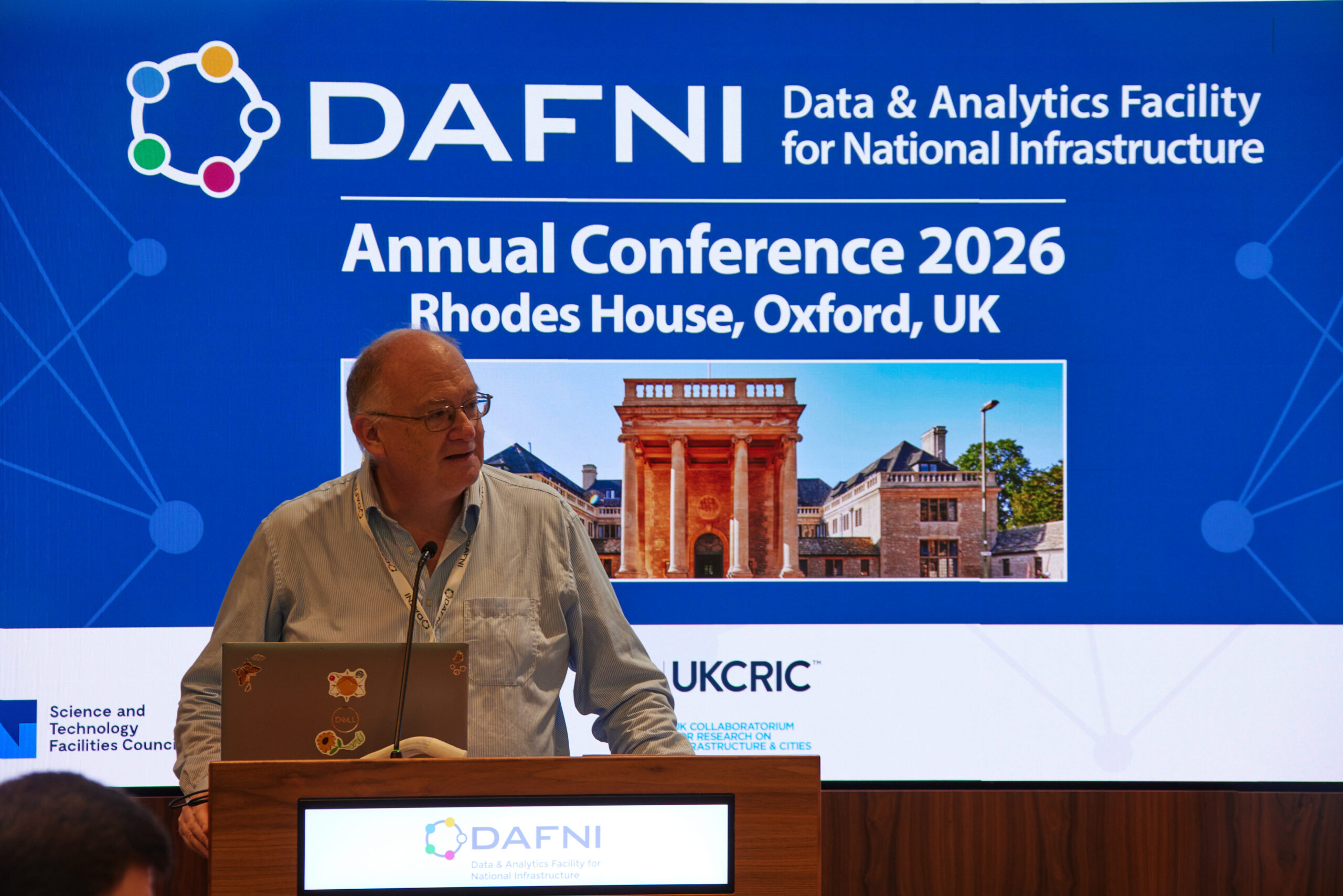
On 10th September 2026, DAFNI held its annual conference at Rhodes House, University of Oxford. This year’s themes were ‘Climate and Security Resilience’ for the morning session, with the afternoon focusing on ‘Government Industrial Strategy, with a focus on Clean Energy.’
DAFNI Programme Lead Brian Matthews welcomed delegates to the conference before handing over to the morning chair, Strategy Board Member, Professor Theo Tryfonas of University of Bristol, to introduce the speaker sessions.
Keynote talk: Margaret Read, Strategy and Policy Director, National Infrastructure and Service Transformation Authority (NISTA)
Margaret outlined the UK’s new 10-year Infrastructure Strategy and NISTA’s systems-based approach to delivering resilient, future-ready infrastructure through stronger coordination across sectors. She highlighted the growing importance of data-driven planning, showcasing NISTA’s ALIGN tool and Infrastructure Pipeline, which support joined-up decision-making and long-term investment planning.
With increasing interdependencies across energy, water, transport and telecommunications, she stressed the need for integrated planning and effective data sharing to meet future demand. Margaret closed her talk by inviting collaboration on shared data, benchmarks, testbeds and evaluation frameworks, and thanked the DAFNI community for helping translate research into real-world impact.
Technical Update on DAFNI: Bethan Perkins, DAFNI Team Lead and Sarah Byrne, DAFNI Platform Product Owner
DAFNI continues to grow as a leading digital platform and research community, connecting infrastructure sectors to share data, expertise and innovations such as AI and digital twins.
Recent improvements on the DAFNI platform include a new Standard Account, upgraded web platform and DAFNI Pages, providing users with a central place to showcase their work, bringing together key assets, publications, affiliations, external links and more.
Looking ahead, a new Resource Catalogue, enhanced workflows and expanded digital twin capabilities will make data and research assets easier to discover and use. Community collaboration remains central, with users helping shape future developments through ongoing engagement and feedback.
Lightning talks – DAFNI Fellows
The 2026 DAFNI Fellows showcased how they are using the platform to tackle some of the most pressing challenges facing infrastructure systems, from climate resilience and flood risk to AI, digital twins and environmental monitoring.
Ji-Eun Byun (Imperial College London) presented work on uncertainty quantification for causality-based models of complex networks using probabilistic graphical models and Bayesian networks. A key innovation is the development of Bayesian network inference algorithms to improve understanding of uncertainty in complex systems. The team plans to deploy the capability on DAFNI and will host a training workshop in February 2027, supporting a long-term goal of developing viable digital twins for complex systems.
Xiaohui Chen (University of Leeds) highlighted the increasing risks that climate change poses to ageing infrastructure, using the example of the August 2026 Lewes rail derailment during extreme heat . His research combines AI, physical sciences and DAFNI through physics-informed machine learning to improve climate adaptation. A co-creation workshop is planned for November 2026, followed by a white paper.
Yitian Dai (University of Manchester) is using DAFNI to assess the climate resilience of electricity networks. Her research investigates how severe weather could affect energy systems over the coming decades and uses simulation to explore how decisions made today could shape resilience through to 2050. A workshop on future energy networks under climate stress is planned for March 2027, bringing together researchers, regulators and network operators.
Amy Green (Newcastle University) discussed the growing challenge of extreme rainfall and its impacts on infrastructure. Drawing on data from rain gauges, radar observations and catchment datasets, her work aims to create trusted, reusable climate resources on DAFNI, including reproducible workflows and visualisations. The project builds on experience from the PYRAMID project, which used DAFNI to support dynamic flood risk modelling.
Manuel Herrera (Newcastle University) is advancing trustworthy AI for flood risk management, focusing on the requirements for infrastructure operators to confidently use AI and data science in decision-making. His work considers system interdependencies and cascading impacts, with plans to link flood models to other DAFNI-hosted models to assess wider infrastructure effects. A workshop on trustworthy AI for infrastructure asset management under climate risk is planned for spring 2027.
Qiuchen Lu (UCL) described how her earlier DAFNI-funded work on the IMPACT (Improving flood disruPted road networks with a dynamic people-Centric digital Twins) project has evolved into a broader programme focused on urban resilience. The project addresses key limitations in current approaches to flood risk management, including static risk maps and limited real-time adaptation. The team’s D-HART digital twin combines transport, weather, drainage and human activity data to assess both pre- and post-event flood vulnerability across London.
Tom Mansfield (Plymouth Marine Laboratory) outlined work on federated data architectures for environmental evidence, with a particular focus on offshore energy. His fellowship is exploring how data integration and decision-support tools can support deployment and planning activities, while making resources such as EQUIFy (Establishing a Framework for Quantifiable Evidence and Impact of Ecosystem Change Throughout the Lifecycle of UK Floating Offshore Wind Farms), VALMAS (Valuing Marine Artificial Structures) and AtlantiS (Atlantic Climate and Environment Strategic Science) project, more accessible through DAFNI.
James McKenna (Newcastle University) presented plans to make advanced hydrodynamic modelling tools more accessible to non-academic users. Building on the SOFRAMODE and Blue-Green Newcastle projects, the team aims to deliver self-service climate modelling capabilities through DAFNI, including support for the CityCAT hydrodynamic optimisation tool. A series of workshops is planned between February and May 2027.
Khuong An Nguyen (Royal Holloway University of London) demonstrated how AI can help predict environmental impacts from major infrastructure projects using HS2 construction data. The research showed that noise and air quality should be managed separately, with noise proving highly predictable due to regular construction activity, while air quality was influenced by factors such as weather, traffic and site operations. Machine learning models accurately predicted noise levels up to an hour ahead, enabling more proactive mitigation.
Finally, Mingshu Wang (University of Glasgow) presented work on GeoAI-enabled scenario planning for resilient urban and transport infrastructure. The project will develop reproducible workflows on DAFNI using tools such as GeoAggregator and the TabPFN-GSA foundation model to support spatial prediction and location-aware decision-making. A stakeholder workshop in April 2027 will explore practical “what-if” scenarios to support infrastructure planning and resilience.
Invited speakers
UrbanAIR
Next was the Invited Speakers session, beginning with Professor Femke Vossepoel of TU Delft on UrbanAIR, a project developing a physics-based digital twin of the urban atmosphere to help cities address rising temperatures and poor air quality. Built within the EU’s Destination Earth initiative, it combines atmospheric modelling, AI-driven data assimilation and high-resolution observations to simulate urban environments at street level. A key innovation is the integration of human behaviour through agent-based models, enabling assessment of how people respond to extreme conditions. The project places strong emphasis on user-centred design, drawing on experience from DAFNI to develop effective and accessible decision-support tools.
CReDO+
James Daniel, UK Power Networks and Elliot Christou, Connected Places Catapult provided an update on CReDO+, an OFGEM SIF-funded project hosted on DAFNI that helps infrastructure operators identify vulnerabilities and assess cascading climate risks. The project brings together partners including SP Energy Networks (SPEN), National Energy System Operator (NESO), National Gas and Cadent to improve resilience to extreme heat, flooding and wind through digital twins, asset risk models and data sharing. A minimum viable product has now been delivered and is being tested with users, demonstrating how the platform can support resilience planning, investment decisions and reduced outage risks.
ENSIGN
Professor Campbell Booth, University of Strathclyde, discussed ENergy System dIGtal twiN (ENSIGN), a project that is developing a whole-system digital twin for electricity distribution networks, co-funded by SP Energy Networks and EPSRC. As electricity demand is projected to rise by 50% by 2035, the project will help networks manage the growing complexity created by renewable energy, electrified heat and transport, energy storage, and emerging technologies. Using real-world network data, ENSIGN will improve demand forecasting, support smarter investment decisions, and enhance system resilience.
Keynote talk: Professor Jim Hall, University of Oxford
In 2015, Professor Hall led the Infrastructure Transitions Research Consortium (ITRC) to develop the National Infrastructure Systems Model (NISMOD), bringing together infrastructure sectors and demonstrating the need for better data access and model integration. This work laid the foundations for DAFNI, which was established through UKCRIC and hosted at STFC Harwell to harness the Science and Technology Facility Council’s expertise in scientific computing.
Built between 2017 and 2021, DAFNI was designed to accelerate infrastructure research by connecting data, models and computing at scale. Today, it supports around 800 users and provides access to almost 1,000 curated datasets, underpinning major initiatives in water resources, transport resilience and climate-risk analysis.
As infrastructure faces growing challenges from AI, cyber security, rising costs and climate change, DAFNI is helping organisations make better decisions across the infrastructure lifecycle. By enabling data-driven research and innovation, it is supporting the development of more resilient infrastructure systems for the future.
Clean Energy Workshop introduction – Professor Robin Preece, University of Manchester
Professor Preece, introduced the Supergen Energy Networks (SEN) Hub, highlighting the need for greater collaboration, data sharing and cross-sector expertise to support the UK’s transition to a secure, low-carbon energy system. With the UK energy network undergoing its largest expansion since the creation of the national grid, the EPSRC-funded Hub is driving interdisciplinary research to ensure energy networks enable a rapid, secure and sustainable energy future.
The Hub connects academia, industry and government through a broad programme of activities, supporting priorities around energy security, industrial growth and the transition to clean power. A notable example is the South Wales Energy Data Platform, developed by Cardiff University researchers, which demonstrates how trusted data sharing and digital innovation can support more resilient energy networks and accelerate progress towards net zero.
Dr Nick Good (Kraken Technologies) discussed the economics of flexible demand, demonstrating how valuable insights can be generated from incomplete energy data. His presentation highlighted the use of proxy signals and inference techniques to identify EV charging from whole-home smart meter data, estimate demand-response savings using runtime telemetry, and assess when the value of additional vehicle data justifies the energy cost of collecting it. The examples illustrated how data-driven approaches can support smarter decision-making across the energy sector.
David Mayne (Cadent Gas) discussed the challenge of transforming fragmented legacy data into integrated, well-governed datasets that can be shared externally. He highlighted the importance of interoperability and the development of a unified data model across the gas sector. Cadent’s top-down data strategy focuses on high-value datasets and business priorities, while remaining adaptable to changing requirements. Key elements of a successful Common Information Model include robust metadata, reliable datasets, strong subject matter expert engagement, and clear data management and sharing policies.
Guy Knapp (NESO) introduced Strategic Spatial Energy Planning (SSEP), a pioneering approach to guiding future energy infrastructure development. SSEP combines economic optimisation with geospatial analysis to identify suitable locations for electricity and hydrogen generation and storage. Its Spatial Evaluation Framework (SEF) assesses sites against environmental, societal, engineering and land-use factors, while scenario analysis balances least-cost, spatially optimised and stakeholder-informed outcomes. A key challenge is integrating diverse datasets across multiple domains, requiring an iterative approach to support effective decision-making.
Clean Energy workshop
The workshop identified shared challenges across energy networks and related sectors, focusing on data, policy, and collaboration. Participants highlighted issues around data granularity, noting that data suitable for broad insights may be insufficient for operational applications, while highly granular data raises privacy concerns.
Discussions emphasised the need for better evidence to inform policy, particularly where current decisions rely on outdated datasets. Successful approaches to influencing policy included government secondments and partnerships with local authorities. Data sensitivity and commercial concerns remain significant barriers to sharing information, although trusted platforms such as DAFNI can help build confidence.
Participants also highlighted the duplication of effort in creating similar datasets across research projects and the need for more sustainable, shared research infrastructure. Strong industry-academic partnerships, built on trust and long-term engagement, were identified as key enablers of innovation. Examples such as the ENSIGN Prosperity Partnership demonstrated the value of industry-led collaboration focused on real-world challenges, particularly as research funding becomes increasingly aligned with industrial priorities.
Close of conference
Closing the workshop, afternoon chair and DAFNI Strategy Board member Professor Asaad Faramarzi, University of Birmingham, offered reflections from across the day, highlighting both how far DAFNI has come and the opportunities ahead. From its conception over a decade ago, DAFNI has evolved into a vital national capability, continuing to adapt to emerging challenges and opportunities, including the rapid advancement of AI.
Brian Matthews praised the outstanding quality and diversity of research presented, the valuable contributions of the DAFNI Fellows, and the strong partnerships forming across the community. Discussions throughout the day had surfaced important challenges around data quality, data sharing, and collaboration, while reinforcing a shared commitment to working together to address them.
The afternoon workshop demonstrated the importance of continued engagement between researchers, industry, government and infrastructure providers. DAFNI remains committed to supporting this community, fostering new collaborations, and enabling research that delivers impact for society.
Finally, Brian gave his sincere thanks to the chairs, speakers, DAFNI Fellows, workshop participants, and the DAFNI team, who look forward to continuing these conversations and working together in the years ahead.
Save the date for the 2027 DAFNI Conference: 9th September 2027, Science and Industy Museum, Manchester